
In-depth analysis of Supermicro SYS-E403-14B-FRN2T: A highly scalable compact server for edge and IoT scenarios

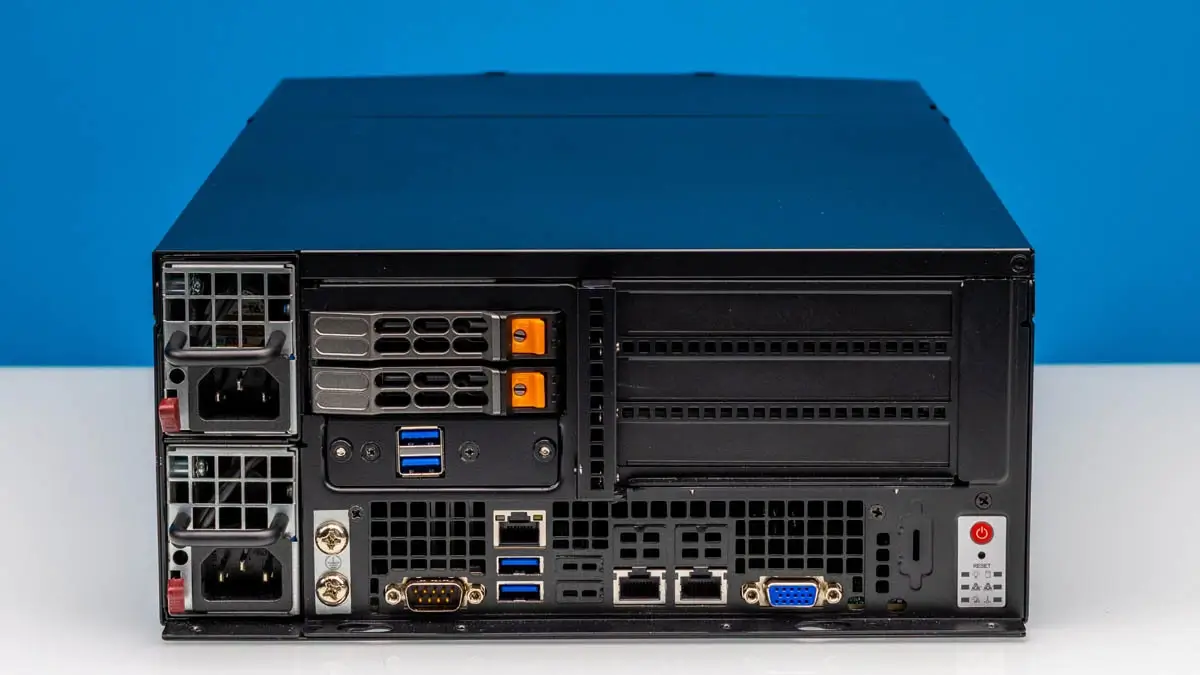
The Supermicro SYS-E403-14B-FRN2T is a compact server platform designed for edge computing and IoT scenarios. Within a limited physical space, it provides multiple PCIe 5.0 expansion capabilities, support for high-power processors, and a flexible front I/O architecture, forming a rare combination of “high scalability + small size”.
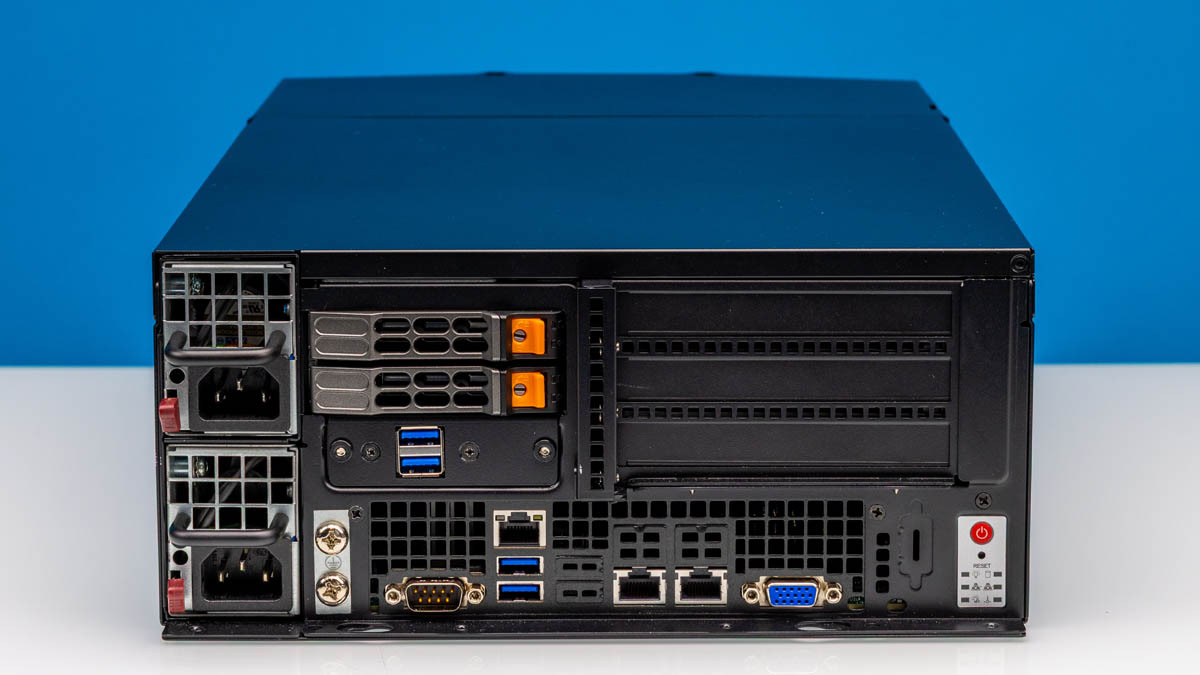
As a key member of Supermicro’s edge server product line, the E403 series has long emphasized customizability and adaptability to complex environments. This model is equipped with an Intel Xeon 6 series processor, supports GPU and high-speed network expansion, making it more practical in scenarios such as edge AI inference, industrial control, video analytics, and network acceleration.
This article will provide a systematic analysis of the SYS-E403-14B-FRN2T from multiple dimensions, including its appearance, internal structure, hardware topology, performance, and power consumption characteristics.
I. Overview of Appearance and Hardware Layout
The most prominent feature of the SYS-E403-14B-FRN2T comes from its compact fuselage size:
The machine measures only 4.62 inches (117.3 mm) × 10.5 inches (266.7 mm) × 16 inches (406.4 mm), a size that is very rare among products with server-level expansion capabilities.
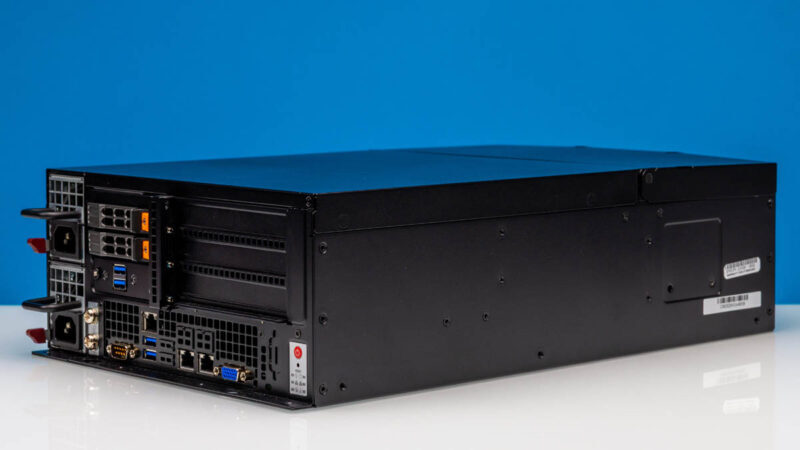
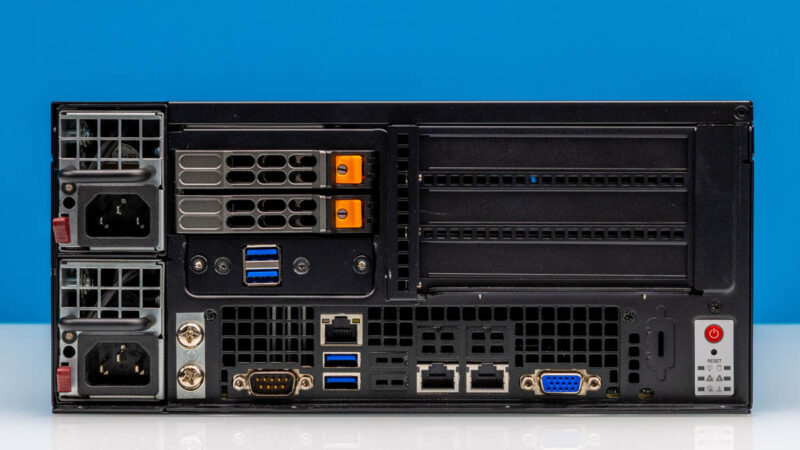
The compact design is largely thanks to its front-panel I/O architecture . The left side of the front panel integrates a redundant power module and features two 2.5-inch NVMe SSD hot-swappable bays. Adjacent to these are two USB 3.0 Type-A ports—in some models of the E403 series, this location still houses USB 2.0 ports, thus improving the peripheral connectivity experience.
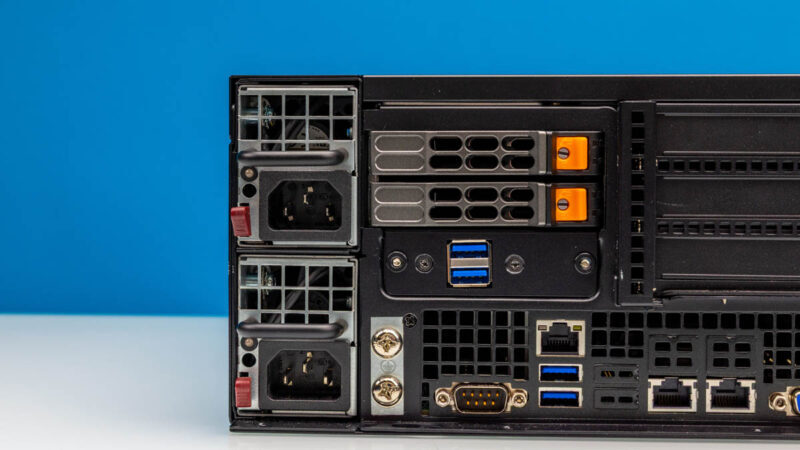
Next to the grounding interface are arranged a serial port, two USB Type-A ports, and an IPMI network port that supports out-of-band management. For networking, the system board has an onboard dual-port 10GbE Ethernet card based on an Intel X550 controller, and a VGA video interface and a group of status indicator lights are also provided.
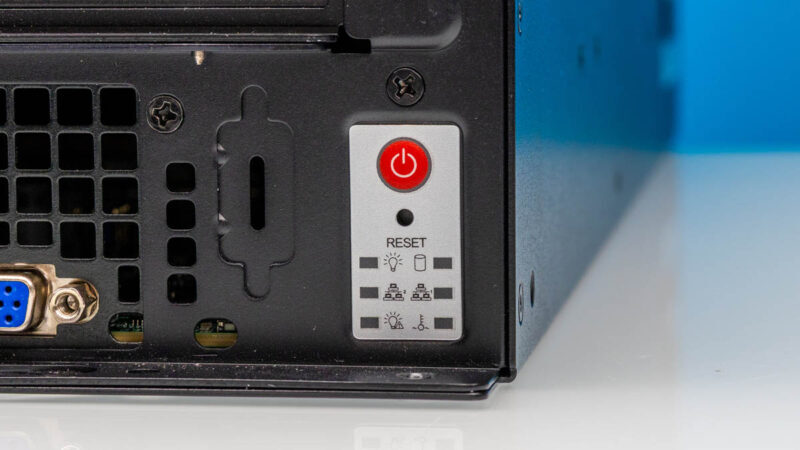
One of the most engineering-worthy design features is the three full-height PCIe expansion slots . This type of design is uncommon in edge server form factors, but it greatly enhances the system’s adaptability, allowing it to deploy GPUs, DPUs, smart network cards, or other accelerator cards as needed.
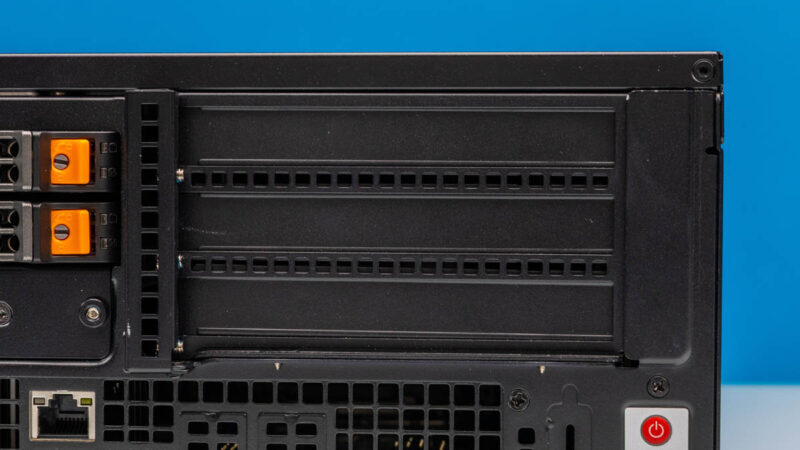
The rear of the chassis only retains the area for the cooling fan. This is because the model adopts a fully front-maintenance design, with all power, network, and I/O connections concentrated at the front, making it suitable for deployment in application environments where rack depth is limited and rear maintenance is not possible.
II. Internal Structure Analysis
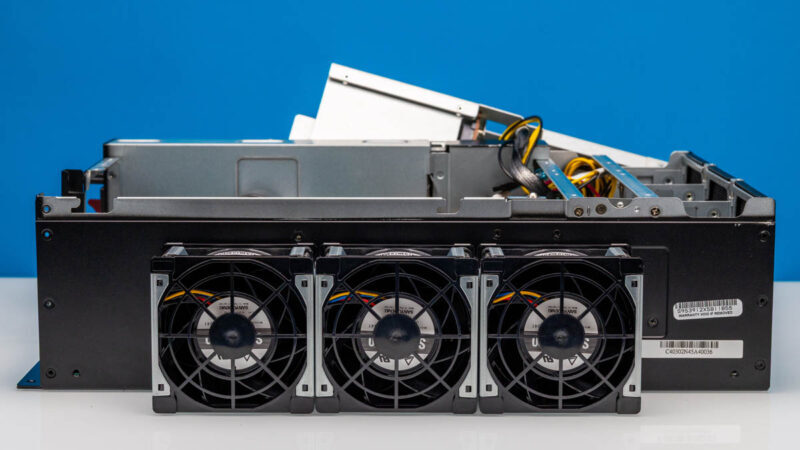
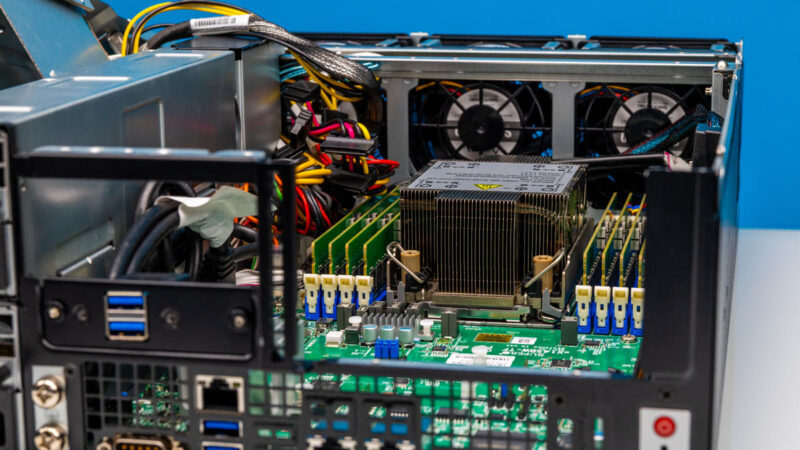
Opening the top cover immediately reveals the server’s highly integrated space utilization. The cooling fans inside the chassis are hot-swappable, facilitating maintenance without affecting system operation.
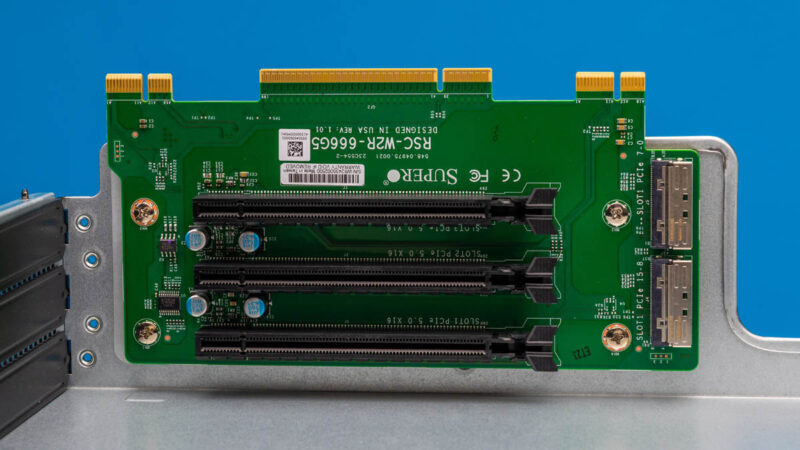
At the edge of the chassis and in the PCIe adapter area, there is a small clip structure for securing and releasing the adapter board. This adapter board houses three PCIe 5.0 x16 slots . To provide sufficient bandwidth for these slots, the motherboard connects to the adapter card via two MCIO x8 interfaces, enabling PCIe lane expansion.
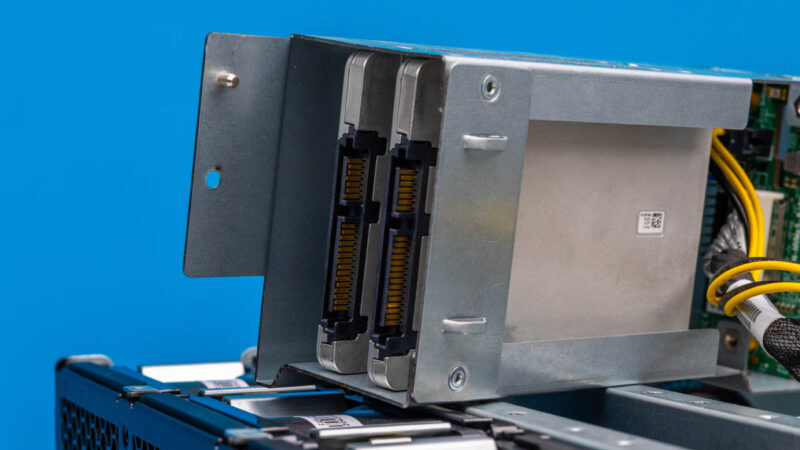
In terms of storage, in addition to the two front-panel U.2 NVMe hot-swappable hard drive bays, the chassis also has two 2.5-inch SATA SSD mounting bays, allowing the entire machine to support up to four 2.5-inch storage devices, balancing high speed and capacity requirements.
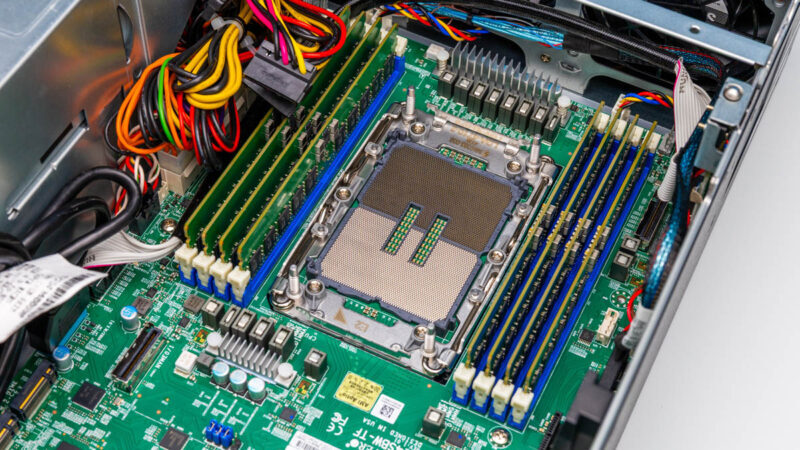
The platform is based on the Intel Xeon 6 series processor socket , supporting the Xeon 6700E series and 6700P/6500P series processors. This series of processors has excellent energy efficiency in networking and edge applications, with the E-core version supporting up to 144 cores, providing ample computing power for multi-threaded and parallel tasks.
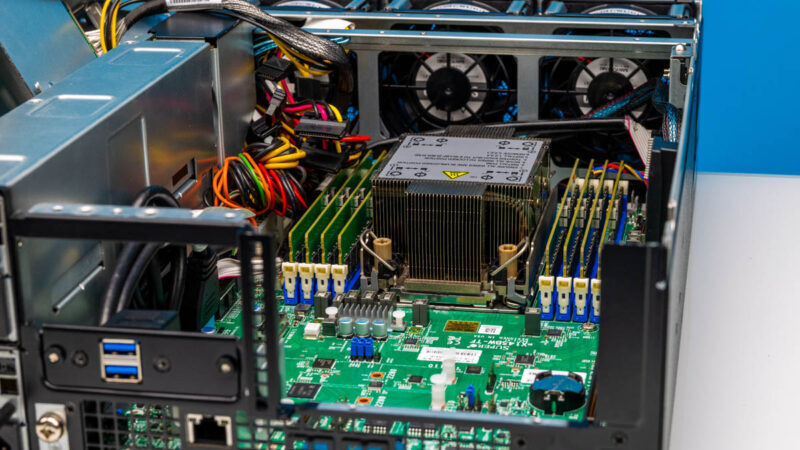
Regarding memory, the system supports 8-channel DDR5, with 1 DIMM per channel. This design sacrifices some capacity, but given the current high cost of DDR5, it prioritizes practical deployability. The cooling system supports processors with a maximum TDP of 300W, providing ample headroom for high-performance configurations.
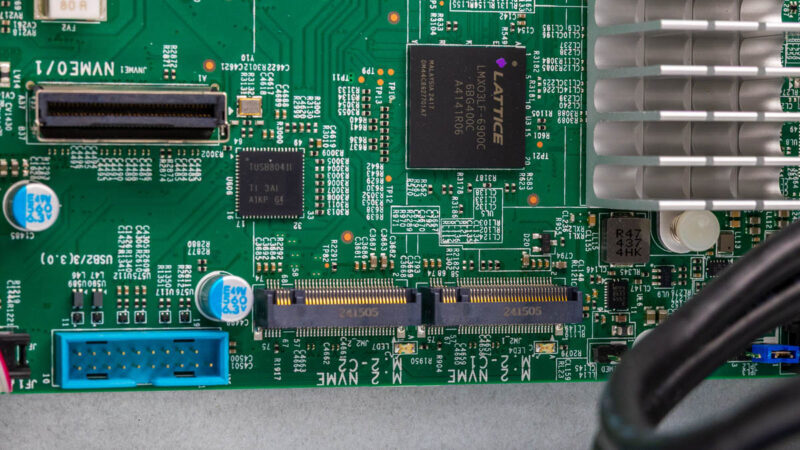
In addition, the motherboard integrates two PCIe 5.0 x2 M.2 slots and multiple MCIO interfaces to support NVMe and PCIe expansion channels. An onboard ASPEED AST2600 BMC controller meets remote operation and maintenance and out-of-band management needs.
III. Hardware Topology
One noteworthy design detail is visible in the system topology: the processor socket is located at the bottom of the machine . This layout is uncommon in conventional servers, but it has become a design feature in the E403 series.
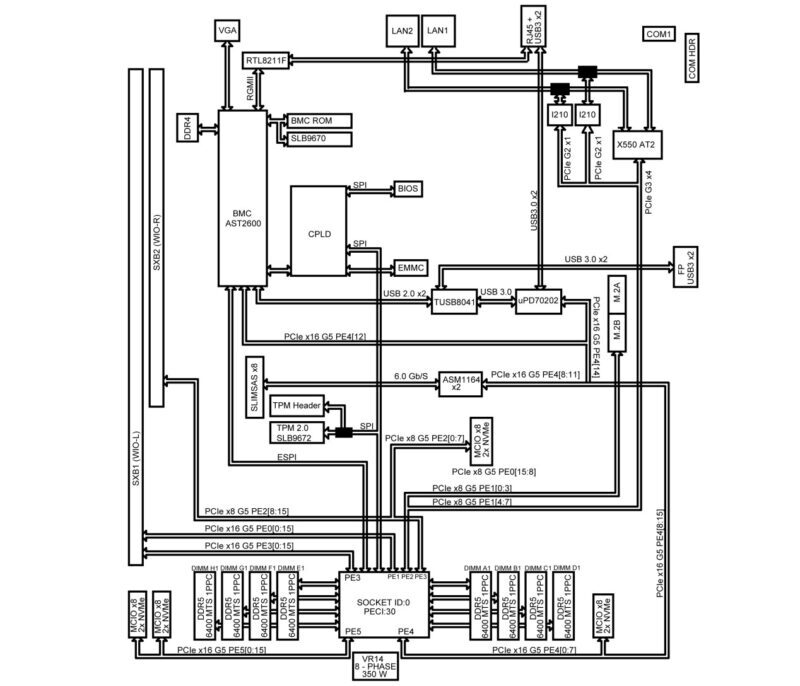
AMD previously released the E403 model based on the Xeon D series, a platform that typically does not require an additional PCH chipset. This Xeon 6 series version continues this approach, resulting in a more compact overall architecture and reducing power consumption and complexity.
IV. Performance
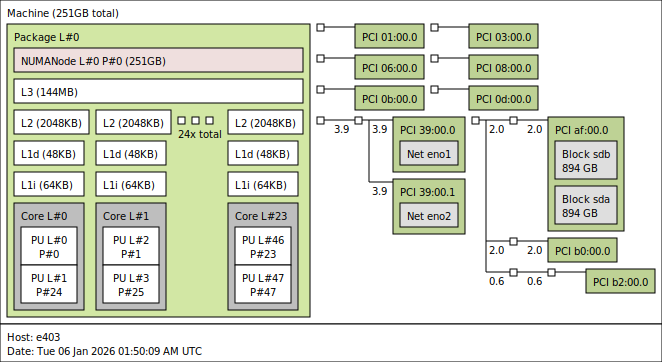
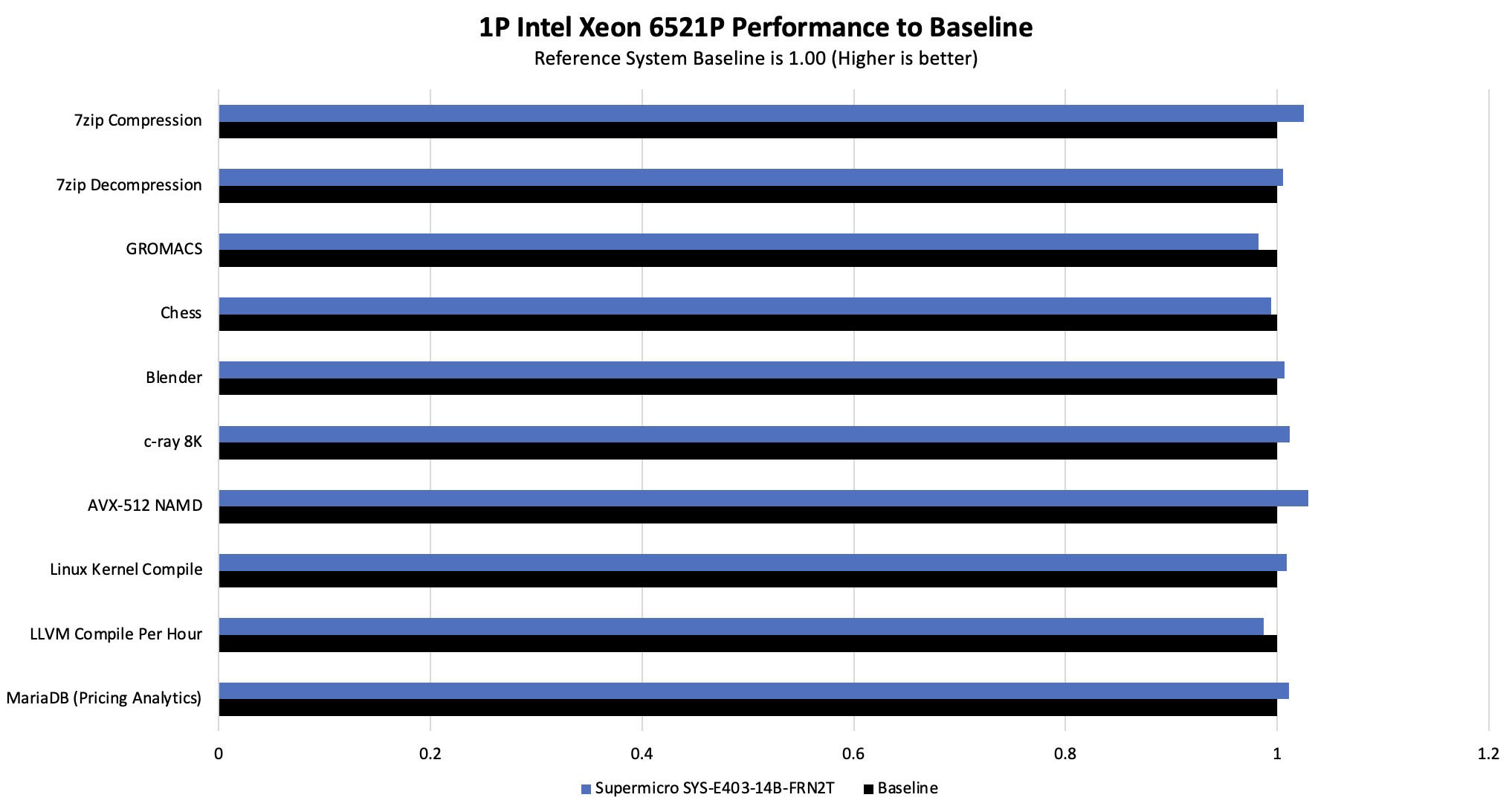
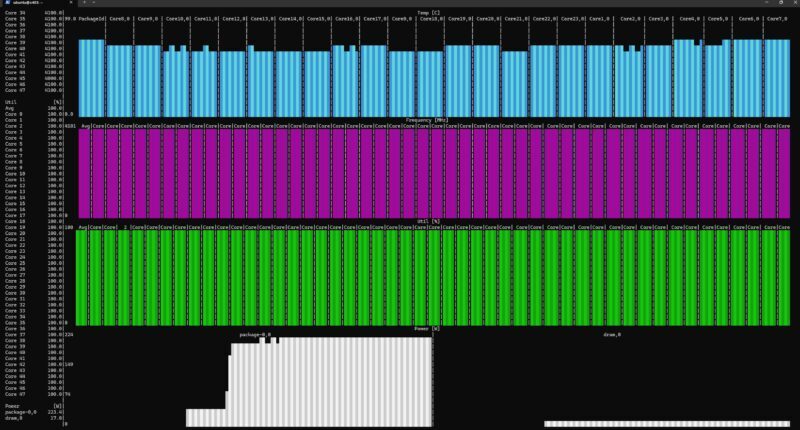
This configuration example uses an Intel Xeon 6521P processor, a 24-core model with 144MB of L3 cache. This processor has demonstrated stable and predictable performance in a variety of general-purpose server scenarios.
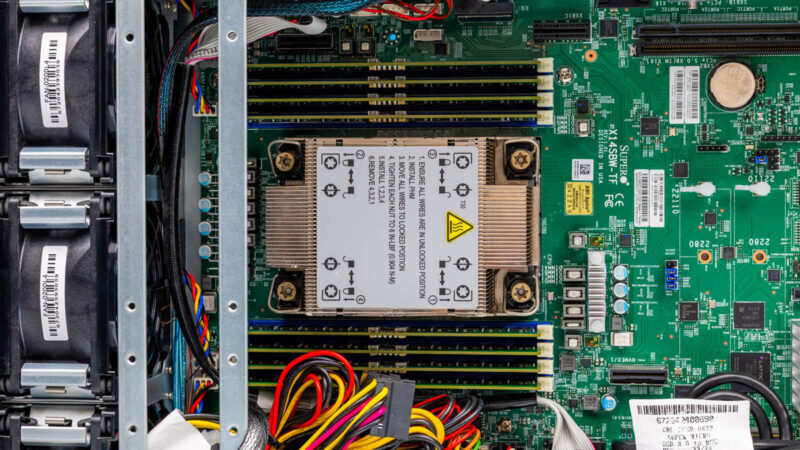
It should be noted that the Xeon 6521P has a TDP of 225W, while the SYS-E403-14B-FRN2T’s cooling capacity is capped at 300W, leaving ample headroom between the two. Under sustained load, the processor frequency and performance output remain stable.
It’s worth mentioning that the platform also demonstrates reliability when expanding with high-power devices. For example, even with dual NVIDIA ConnectX-7 400Gbps network cards deployed, the system maintained stable operation, which indirectly verifies its engineering reliability in terms of thermal design and power supply stability.
V. Power Consumption and Operation
The SYS-E403-14B-FRN2T comes standard with dual 800W 80PLUS Platinum certified redundant power supplies, and also supports single power supply configurations.
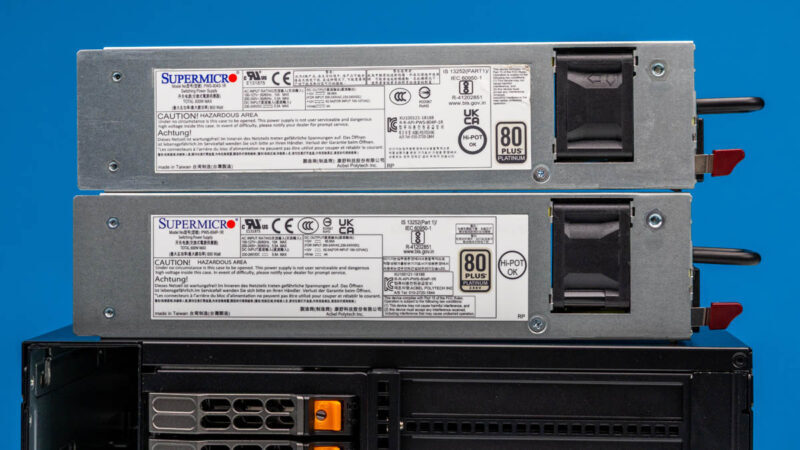
Under full processor load, the CPU package power consumption is approximately 225W, and the overall system power consumption varies significantly with the load. Actual measurements show that the system idle power consumption is below 200W, while under full load it approaches 400W.
As it is positioned as an edge and industrial application server, this platform is not designed for quiet operation and will generate noticeable wind noise when running under high load, which is a typical characteristic of high-power compact servers.
VI. Platform Positioning and Applicable Scenarios
The SYS-E403-14B-FRN2T is not a product that pursues the ultimate density; its core value lies in its ability to expand its freedom of choice and adapt to different platforms .
With three PCIe 5.0 x16 slots, users can flexibly deploy GPUs, DPUs, smart network cards, or combinations of various accelerator cards. Whether building edge AI inference nodes, network acceleration nodes, or industrial data acquisition and analysis systems, this platform provides a reliable physical and bandwidth foundation.
This type of scalability is not common in compact server form factors, and it is one of the core differences between this platform and traditional microservers.
Summarize
The biggest highlight of the Supermicro SYS-E403-14B-FRN2T does not simply come from its computing power, but from its highly customizable capabilities within a compact space .
Through its front I/O design and the combination of three full-height PCIe slots, it can support a variety of heterogeneous configurations:
Whether deploying multiple high-speed network cards, dual-slot GPUs with network expansion, or building a hybrid architecture with multiple accelerator cards, this platform offers ample adaptability. Compared to the previous E403 series based on Xeon D, the new generation Xeon 6 series platform brings higher core density, greater memory bandwidth, and introduces QAT hardware acceleration capabilities, significantly improving its practicality in scenarios such as AI inference, encryption, compression, and network processing.
In the current market environment, traditional microservers are gradually moving towards higher price ranges, but they still have significant limitations in terms of network capabilities, PCIe expansion, and maintainability. In contrast, the SYS-E403-14B-FRN2T, although slightly larger and positioned higher, covers many task types that are difficult for microplatforms to handle.
This is a solution that balances size, scalability, and engineering reliability for users who need to deploy AI inference, network acceleration, industrial control, or localized analytics systems at the edge.
【Empowering Innovation】Shenzhen Haoyuan Nuoxin has long provided customers with various AI server hardware and software integrated solutions, from hardware selection and solution design to system deployment and optimization, helping edge computing power to be truly transformed into practical productivity.