
All-Flash Server Solution for Real-Time Financial Analytics
As AI technologies such as AIGC and large-scale models continue to evolve, the financial investment and research sector is entering a new phase of intelligent transformation.
Traditional analytics platforms increasingly struggle with:
- High-frequency trading workloads
- Massive volumes of unstructured data
- Real-time forecasting and decision support
- Strategy backtesting at scale
Bottlenecks in compute density, storage throughput, and system responsiveness can directly impact model efficiency and trading performance. In scenarios involving multi-source heterogeneous data ingestion, real-time market prediction, and large-scale strategy simulation, infrastructure scalability and I/O performance become mission-critical.
To address these challenges, a high-performance 2U all-flash AI server platform was deployed for a financial institution. The solution integrates the GRAID SupremeRAID™ SR-1010 storage acceleration engine, significantly enhancing storage bandwidth and concurrent response capabilities to support data orchestration, model training, and quantitative strategy simulation workloads.
Why Financial AI Workloads Are Storage-Constrained
In AI-driven financial environments, storage performance is often as critical as compute power. Three primary bottlenecks are commonly observed:
1. Rapid Growth of Unstructured Data
Financial text corpora, chart datasets, trading logs, and multi-modal data streams continue to expand.
Data preprocessing and model training pipelines increasingly depend on high-throughput storage. Traditional architectures struggle to keep pace with sustained read/write demand.
2. Multi-Model Deployment and High-Concurrency Access
Quantitative research platforms frequently run multiple strategies and AI models in parallel.
Frequent access to parameter files, intermediate results, and historical datasets places heavy stress on I/O schedulers. Low-latency and high-concurrency storage access is essential to maintain workflow efficiency.
3. Strategy Backtesting and Market Simulation
High-frequency backtesting and microsecond-level response requirements demand:
- Large-scale dataset retrieval
- High sequential and random read performance
- Stable throughput under sustained concurrency
Storage subsystems must provide not only sufficient capacity, but also consistent high-bandwidth performance to support near real-time simulation and predictive modeling.
Solution Architecture: High Performance × Scalability × Reliability
High-Performance All-Flash Platform
The solution is built on a PCIe 5.0 high-speed architecture and fully populated with:
- 24 × 30TB enterprise NVMe SSDs
- Total raw capacity of 720TB
- Designed to scale toward PB-level data workloads
This architecture provides high-throughput processing capabilities for data-intensive financial research environments, including:
- Large-scale data ingestion
- High-speed query workloads
- Model training pipelines
- Real-time inference preparation
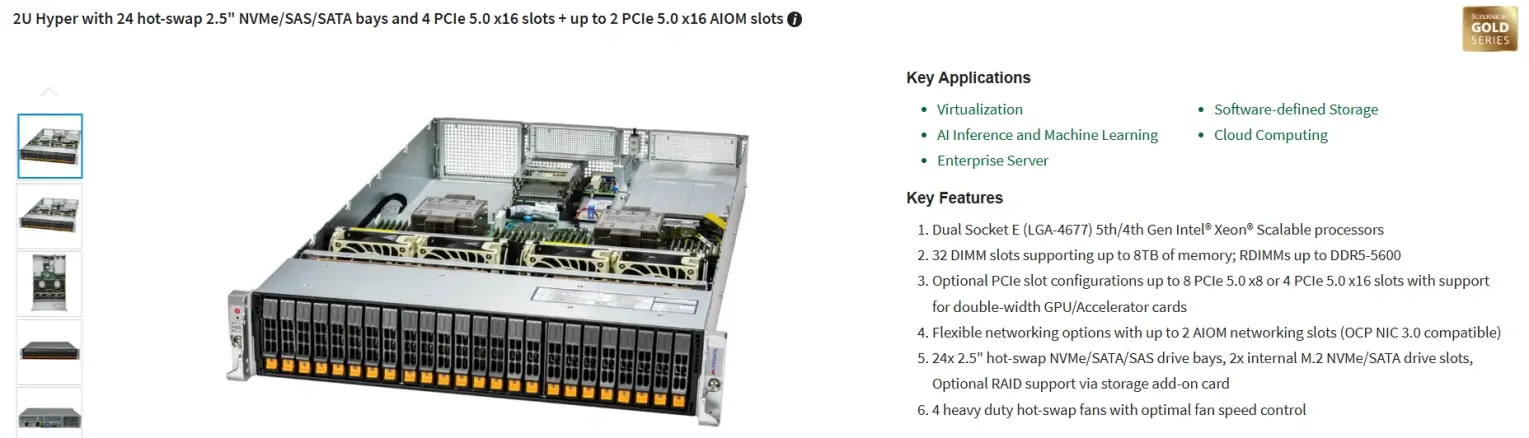
The platform also allows future expansion toward AI inference nodes, distributed scheduling modules, and localized large-model deployment.
GRAID SupremeRAID™ SR-1010: Unlocking NVMe Performance
The integration of the GRAID SupremeRAID™ SR-1010 software-defined RAID accelerator enables substantial performance improvements:
Extreme Performance
- Up to 28 million IOPS
- Up to 260GB/s throughput
- Eliminates traditional hardware RAID bottlenecks
This significantly enhances efficiency for data-intensive AI and quantitative workloads.
GPU-Accelerated RAID Architecture
RAID computation is offloaded from the CPU to GPU architecture, which:
- Frees CPU cores for critical analytics tasks
- Improves concurrency handling
- Enhances overall system responsiveness
Native NVMe & NVMe-oF Support
- Supports up to 32 local NVMe SSDs
- Fully utilizes PCIe Gen 3/4/5 bandwidth
- Enables near-linear storage performance scaling
High Availability & Maintainability
- Battery-free RAID design eliminates battery degradation risk
- Improved long-term reliability
- Reduced maintenance overhead
Cross-Platform Compatibility
- Supports Linux and Windows environments
- Flexible integration into enterprise financial infrastructures
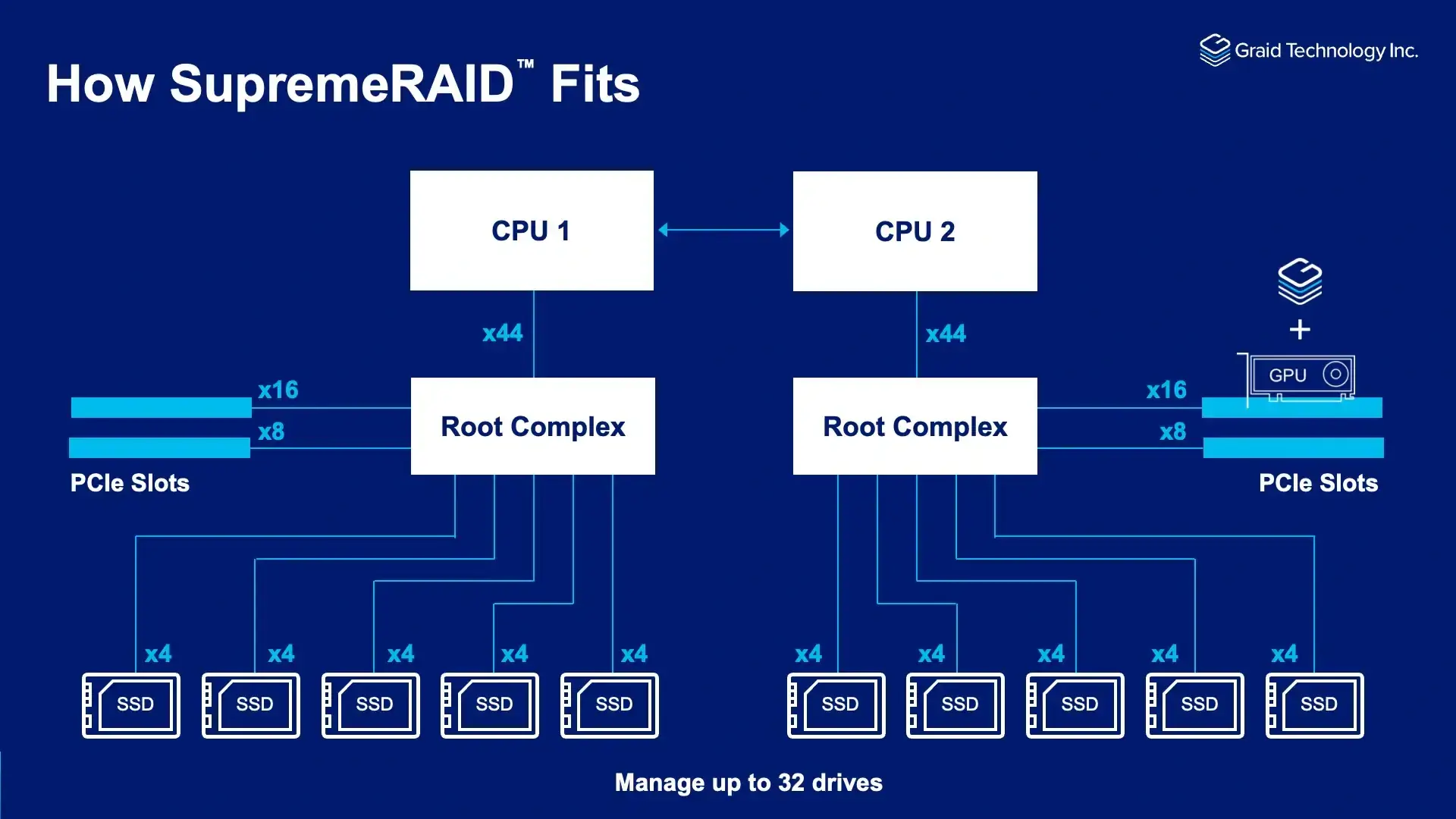
In performance validation tests, the platform demonstrated stable high-throughput read/write capability under concurrent workloads, ensuring continuous data supply for AI model training and real-time inference.
Building the AI Infrastructure Foundation for Financial Intelligence
As financial institutions transition toward AI-driven investment research and decision-making, infrastructure must evolve from traditional storage architectures to high-performance, scalable, and intelligent platforms.
We focus on delivering integrated AI infrastructure solutions that combine:
- AI servers
- High-performance computing platforms
- Private model deployment environments
- High-throughput storage clusters
Through vertically integrated hardware and software optimization, the goal is not only to provide compute capacity, but to enable deployable, production-ready AI capabilities.
By shortening the path from infrastructure deployment to analytical value realization, organizations can accelerate innovation cycles and enhance competitiveness in increasingly data-driven financial markets.
Compute drives intelligence. Storage sustains performance.
A resilient all-flash foundation is essential for real-time financial analytics at scale.